
Blog Post #5: The Revenant and Manifest Destiny
- Nov 28, 2016
- 2 min read
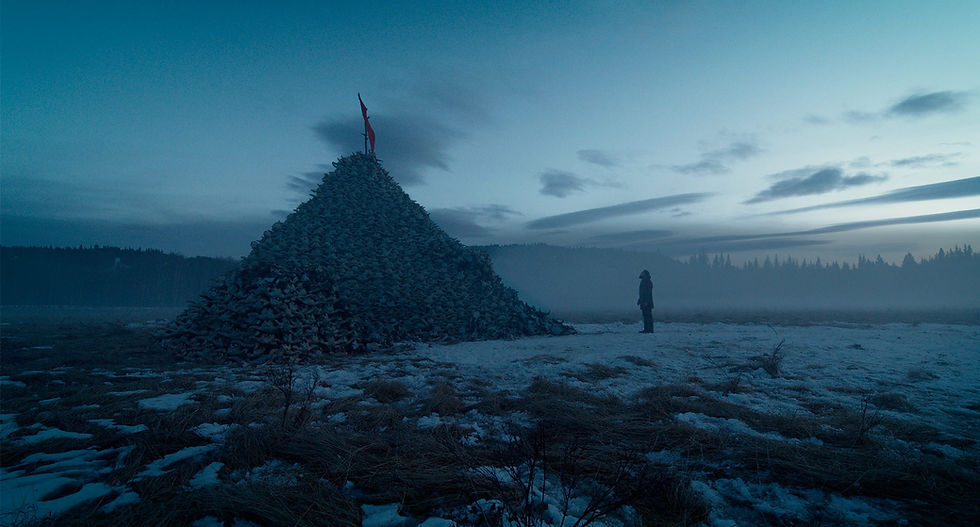
In director Alejandro Inarritu's latest film, The Revenant, American westward expansion is illustrated in a stark manner, exposing the realities of cruel natural conditions and the gruesome aspects of human nature. This view is in great contrast to the widely believed doctrine in the 18th century United States of Manifest Destiny, the notion that this movement across the country was not only natural and predetermined, but also divinely encouraged (Lazo, Lec 15). Whether or not the Anglo-Saxons had a right to spread their influence across the continent is beside the fact. The primary point is that westward expansion was not the simple, idealistic process that people like the artist John Gast viewed it as.

While the American frontier in winter is a beautiful sight to behold, as captured in Inarritu's shots, it is also very dangerous. This is illustrated in the opening scene of the movie where a white man is shown burning down a Pawnee home, leaving the mestizo boy, Glass' son, homeless and, as the audience soon discovers, motherless. The next scene portrays the Pawnee tribe massacring Glass' group of fur trappers. The group narrowly escapes, most of its members perishing from taking arrows to the jugular. From their harsh battle cries to their brutal killings, the Pawnee at first seem to be the savages in this narrative. It is not until the character of John Fitzgerald is introduced that the line between the supposedly civilized individuals and barbarians becomes blurred.
This grey zone first becomes evident with the way Fitzgerald refers to Glass' son, Hawk, and the Pawnees in general. His hatred is first expressed verbally only. However, after Glass is mauled by a bear, Fitzgerald's hatred begins to gush out. He hates Glass with all of his being, partially because Fitzgerald is jealous of Glass and his knowledge and also because Glass can speak the Pawnee language and had romantic relations with a Pawnee woman, therefore, in Fitzgerald's eyes, betraying his own people by adopting the culture not his own. However, this adoption of the Pawnee ways of life is what ultimately saves Glass' life. Not all frontiersmen were as fortunate as DiCaprio's character. They, too, had to wager their lives in the wild.
Another illustration of the dangers of the wild can be found in the scene where Glass is mauled by a bear. As a fur trapper, like so many men of his era, he had to risk his life in order to make a living. Death is a simpler option compared to the one chosen by Glass and many of the individuals who participated in Manifest Destiny, deciding instead to grit his teeth and continue on to avenge the death of his son. Yet death is still a key component in Glass' and every other frontiersman of the 18th century's journey, affecting the animals, Natives, and fellow travelers that each person encountered.
__________________________________________________________________________________________
Sources:
Lazo. Humanities Core Lecture 15. November 16, 2016.
Innaritu, Alejandro. The Revenant. Film. 2015.


Comments